

The power of slowing down in a B&B
A mini reset often starts not with a big decision, but with a small realisation: that your head is full, your days all feel the same, and you haven’t really paused for some time to check in with how you’re doing. In a B&B in South Limburg, such as De Smockelaer B&B, something special happens the moment you put your bag down. The pace shifts, the sounds soften, and suddenly you remember what it feels like to simply be, instead of constantly having to do.
When breaks aren’t really breaks
Many people feel it somewhere around the middle of the week. The body keeps going, but the mind lags behind. There’s tiredness that’s hard to fully explain, a slight irritability, a feeling as if a to-do list is constantly running in the background. Then comes the thought of a weekend away, a quick escape, something to look forward to.
Yet such a short break often turns out to be less restorative than hoped. The travel is hectic, the schedule full, the expectations high. Things have to be seen, tried, shared. It feels different for a moment, but not truly calmer. The pace of home simply travels with you.
At De Smockelaer B&B, it’s striking how often guests talk about this on arrival. They come in rushed, with heads full of appointments, plans and notifications. The first question is still often about what there is to do in the area: where they absolutely have to go, what they mustn’t miss. Only later—usually after the first night—does the conversation change.
From escaping to truly resetting
There’s a difference between wanting to get away from everything for a bit and experiencing a mini reset. Escaping is mainly about taking distance from what feels pressured, finding a different environment in the hope that things will feel lighter. A reset goes deeper. It’s about feeling again what matters, noticing what your body and mind have actually been trying to tell you for quite some time.
In a B&B in South Limburg, you notice that resetting isn’t about grand gestures, but about small changes in rhythm. At De Smockelaer B&B, that sometimes starts with the view. The hills, the shifting light, the silence that isn’t emptiness but filled with birds, wind, perhaps a distant tractor. It’s an environment that doesn’t shout for attention, but invites you to look more slowly.

Guests often say that after just one day they notice their breathing becoming calmer, their steps slower, their thoughts less tangled. Not because someone has told them it’s time to relax, but because the environment naturally creates room for it.
How a small scale dampens the noise
A mini reset doesn’t call for more stimuli, but for less. A B&B is, by definition, smaller, clearer, more human. That sounds simple, but for a busy mind it makes a huge difference.
At De Smockelaer B&B there are no anonymous streams of people, no endless corridors or large lobby. There’s a homely scale, familiar faces and a rhythm shaped not by rules, but by the day itself. You see the same table again at breakfast, the same corner chair by the window, the same path through nature.
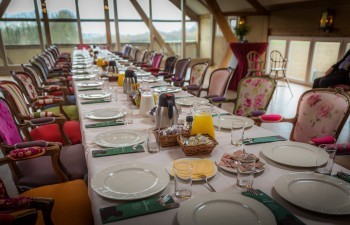
That familiarity strips away a layer of noise. You have to choose less, compare less, switch gears less. Staying overnight in nature becomes almost self-evident. The choices shrink to small things: a short walk before or after breakfast, another cup of coffee, or simply staring outside in silence for a while.
At De Smockelaer B&B, you often see just how well that simplicity works. Guests who plan everything tightly at home will, after the second day, almost without noticing, leave their watch to one side. There’s less urge to fill every moment, more space to do nothing for an hour without it feeling lazy.
The role of silence, routine and attention
Slowing down can sometimes sound big, almost theoretical. In practice it’s very tangible. Silence, routine and attention play a major part.
Silence here isn’t completely soundless, but soft. You hear the morning sounds outside, cutlery at breakfast, a voice in the background. No loud music, no constant announcements, no dense crowds. That softer layer of sound lets thoughts drift rather than pile up.
Routine emerges naturally during your stay. Waking up without immediately opening an agenda. Walking calmly to breakfast, starting the day with a simple question: what do I feel like, instead of what all has to be done. Maybe it becomes a walk, maybe a book. The repetition of such a simple morning—especially if you stay longer than one night—gives the nervous system something to lean on.
Attention often returns in small moments: the conversation with the host, the careful brewing of coffee, the way the tablecloth is straightened. At De Smockelaer, it stands out that guests remember precisely those details. Not the big stories, but the feeling that someone truly listened to them for a moment, without hurry.
Why the morning matters so much
When people think of a mini reset, they often focus on the evening—resting after a busy day. Yet the difference usually starts in the morning. How the day begins colours everything that follows.
At De Smockelaer B&B, morning is often when guests surprise themselves. On the first day, many still arrive at breakfast feeling restless, sometimes with a phone in hand, still half in the working week. By the second morning, you see something different. People look outside for longer. There’s time to taste, not just to eat. The conversations are no longer about yesterday, but about how good it felt not to have to do anything for a while.

The first morning is the transition; the second morning is the turning point. That’s why a stay of at least two nights is so powerful. In one night you mainly take the sharpest edge off. In two nights, the rhythm truly changes. The evening in between forms a bridge: a stretch of time when you’re not travelling, not packing or planning, but simply present.
At De Smockelaer, you notice that guests who stay three days often put into words most clearly what has happened. They arrive with a full head and leave with sentences like: it feels lighter, there’s space again, I’m looking differently at the coming week. It’s not a spectacular turnaround—more a shift—but it’s precisely that shift that makes everyday pressure feel different afterwards.
The line between being away and coming back differently
A B&B in South Limburg doesn’t only help you find rest during your stay, but also helps you take something home with you. That isn’t in grand insights, but rather in a few concrete memories.
The morning sun on the bed. The silence when you open the door. The taste of a simple breakfast you could eat without hurry. The walk where you noticed your shoulders were lower than you thought. The uncomfortable, but valuable moment when you realised you might take too few breaks at home.
At De Smockelaer B&B, you often see that guests drive home differently than when they arrived: calmer, with less haste, sometimes with an agreement to truly do things differently at home. Not perfectly, but consciously. That transition—from escaping to living more intentionally—may well be the core of a mini reset.
Choosing rest intentionally
Slowing down isn’t a luxury, but a choice that has to be made again and again. It doesn’t necessarily require faraway trips or big plans. Sometimes a few nights staying overnight in nature is enough to feel your own compass again for a moment.
A place like De Smockelaer, with the calm atmosphere of a B&B and the surrounding hilly landscape, offers a natural foundation for that. Not by pushing or persuading, but simply by being an environment in which nothing has to be louder or faster than it needs to be.

The power of such a mini reset ultimately lies in how you relate to it yourself. Do you dare to let go of the agenda, switch off the screen for a while, allow the discomfort of silence. Do you dare to admit you need rest—not as weakness, but as a form of care for yourself and for the people around you.
Guests leaving De Smockelaer B&B often put it simply. They feel lighter than when they arrived, as if something invisible has fallen away, even if they can’t pinpoint what. Perhaps that’s what slowing down truly does. It doesn’t remove everything, but makes it manageable again—clearer, more human.
Making room for a different way of being
A mini reset doesn’t begin only when you check in somewhere, but the moment you decide you’ve had enough of always carrying on. Whether you choose a stay at De Smockelaer B&B or another B&B in South Limburg, it’s already a step if you consider rest important enough to make time for it. Perhaps that is the most essential form of slowing down: acknowledging that you don’t have to carry everything at the same pace as yesterday.
Why can a short stay sometimes feel deeper than a long holiday?
A long holiday is often packed with plans and surrounded by expectations. Everything has to be fun, special and a success all at once. On a short stay—especially in a quiet B&B—the pressure is lower and there’s more room for simple moments. That helps you get to what you truly need sooner, rather than what you think you’re supposed to experience.
How does a B&B like De Smockelaer B&B help with a mini reset?
De Smockelaer B&B offers a small-scale, personal environment where the rhythm naturally slows down. Thanks to its location in nature, the human scale and the calm atmosphere, it’s easier to step back from everyday noise. It’s not a place where everything revolves around entertainment, but around being present—so a mini reset can arise almost by itself.
Is one night enough to truly slow down?
One night can already do you good, but often feels like a glimpse. You get a taste of how calm it can be, but for a real shift in pace, two nights is usually more powerful. You use the first night to land and release tension; the second morning and night create space for a different rhythm. At De Smockelaer B&B, that pattern is recognisable for many guests.
What makes staying overnight in nature so different from the city?
In nature, stimuli are softer and slower. The light changes gradually, sounds are less sharp, the horizon is wider. This helps the nervous system to calm down. In and around De Smockelaer, you notice that for example in the silence of early morning and the tranquillity of the hilly landscape. That environment invites you to walk, look and breathe at a slower pace.
How do I prevent a mini reset from feeling like something I also have to “perform”?
By consciously setting the bar low. Don’t choose too many plans, keep the days simple, and allow moments when you feel a bit bored. In a B&B like De Smockelaer, the environment already helps by not offering an endless list of impulses. You don’t have to tick anything off; you can let the days unfold as they come.
Why do guests often feel “lighter” when they leave?
That lighter feeling often comes because tension has been released invisibly. In a calm environment like De Smockelaer B&B, the body settles, sleep improves and there’s space for thoughts to drift. Less is required for a while, more is allowed to be felt. What remains is an experience of space and clarity that feels lighter than on arrival.
Can a mini reset also change how I live at home?
A short stay doesn’t change life overnight, but it can be an important turning point. You feel again what a calmer pace is like, what it’s like to be without constant stimulation. Many guests take small habits home with them, such as eating breakfast more slowly, going outside more often, or planning more screen-free evenings. In that way, De Smockelaer works not only as a B&B in South Limburg, but also as a quiet reminder that things can be different.